
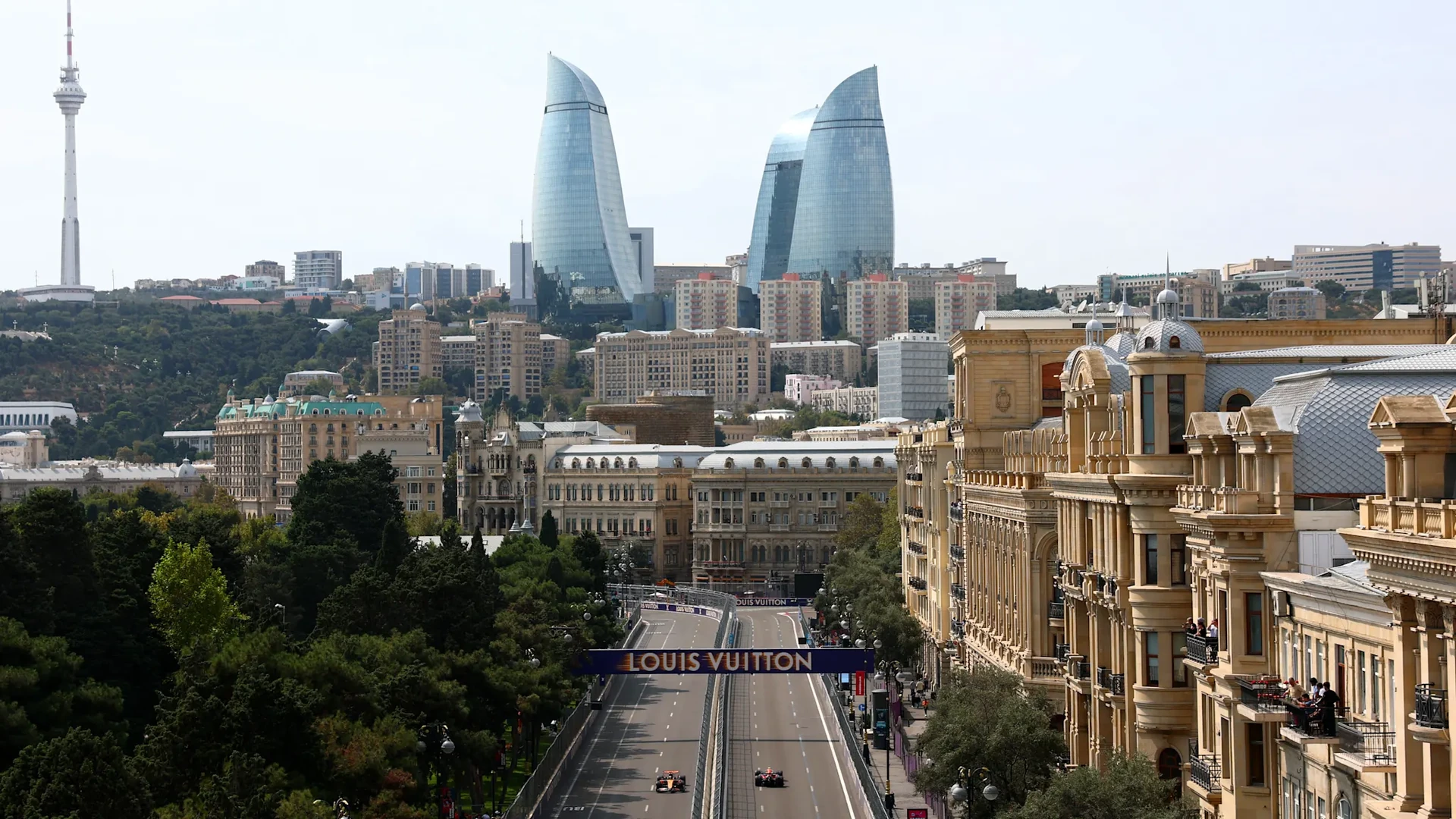
Lando Norris and Oscar Piastri will arrive in Baku for a street circuit that asks a Formula 1 car to solve two opposing problems. The long waterfront run rewards low drag, while the narrow castle section demands stability, accurate placement and confidence at lower speed. McLaren cannot optimise one part in isolation because the final setup must protect qualifying performance and remain manageable in traffic during the race.
The main straight rewards efficiency
Cars accelerate along the waterfront before braking heavily for the first corner. A lower-drag configuration improves speed and makes overtaking or defending more realistic.
Too little aerodynamic support can make the rest of the lap harder to control. Norris and Piastri therefore need a compromise that remains fast without making every slow corner a correction. Brake temperature is part of the compromise. The long full-throttle section cools some components before a severe stop at Turn 1, while repeated slow corners create a different demand later in the lap. McLaren must keep the system inside its working range without asking the drivers to perform complicated corrections at every braking zone. Consistent pedal response is especially valuable when the walls leave no runoff for an uncertain first attempt.
The castle section punishes small errors
The passage through Turns 8 to 10 is among the narrowest on the calendar. There is little space to recover if a wheel touches the wrong line or the rear of the car moves unexpectedly.
Drivers build confidence through repeatable braking and steering rather than one aggressive attempt. A stable platform can be worth more there than a small theoretical gain elsewhere. Tyre preparation creates another choice. A driver needs enough temperature for the first sector, but pushing too hard on the out-lap can reduce grip before the lap reaches the castle section. Norris and Piastri may use different warm-up details while aiming for the same result: a tyre that responds immediately and remains predictable through the final corners. Practice offers the only responsible place to test those sequences.
Qualifying and racing ask different questions
A clear qualifying lap lets a driver use the full track without dirty air. The race adds slipstream, tyre management and changing gaps to other cars.
McLaren must choose settings that do not create an advantage for one lap and a serious weakness over a complete stint. Both drivers’ comments during practice should help expose that trade-off. The tow can produce speed and also disturb a carefully planned lap. Following another car along the straight reduces resistance, but turbulent air may weaken front grip when the route turns. In qualifying, the team must decide whether a possible slipstream is worth the risk of catching traffic. In the race, the same effect changes overtaking, battery use and the distance needed to defend into the first corner.
Track evolution changes the reference
A temporary circuit begins the weekend with less rubber than a permanent venue. Grip increases as sessions continue, but dust and interruptions can make the improvement uneven.
Engineers need to distinguish a genuine setup gain from a faster surface. That separation prevents the team from adjusting a car that was already moving in the right direction. Both McLaren drivers also need confidence at pit entry and on restarts. Baku can compress the field after an interruption, placing cold tyres and heavy fuel into the same narrow braking zones. The steering wheel settings used for deployment and differential behaviour must be prepared before that moment arrives. A calm restart is not a separate skill from setup work; it depends on the car behaving as the driver expects.
Baku rewards a complete weekend
The circuit’s reputation for surprise does not make preparation less important. Good braking references, reliable pit work and calm restarts can limit the effect of uncertain events.
Norris and Piastri have separate driving preferences, so the final details do not have to be identical. The shared objective is a car that gives each driver clear information at both ends of the speed range. Comparing the two cars will help only if the experiments are controlled. Splitting wing levels or suspension settings can collect more information, yet large differences may leave the engineers unable to isolate the cause of a gain. McLaren should use the opening session to answer broad questions, then bring both programmes closer together. The final choice needs evidence from representative laps rather than one unusually favourable sector. Practice data will show whether the chosen compromise survives both parts of the lap. A setup that looks quick through one speed trap is incomplete if the driver cannot place the car confidently beside the castle walls.

No Comments