
The Formula 1 Commission has agreed a group of regulatory changes for 2027, including a shorter standard race distance, a hard stop for disrupted events and the removal of gearbox homologation. The measures still require approval from the FIA World Motor Sport Council.
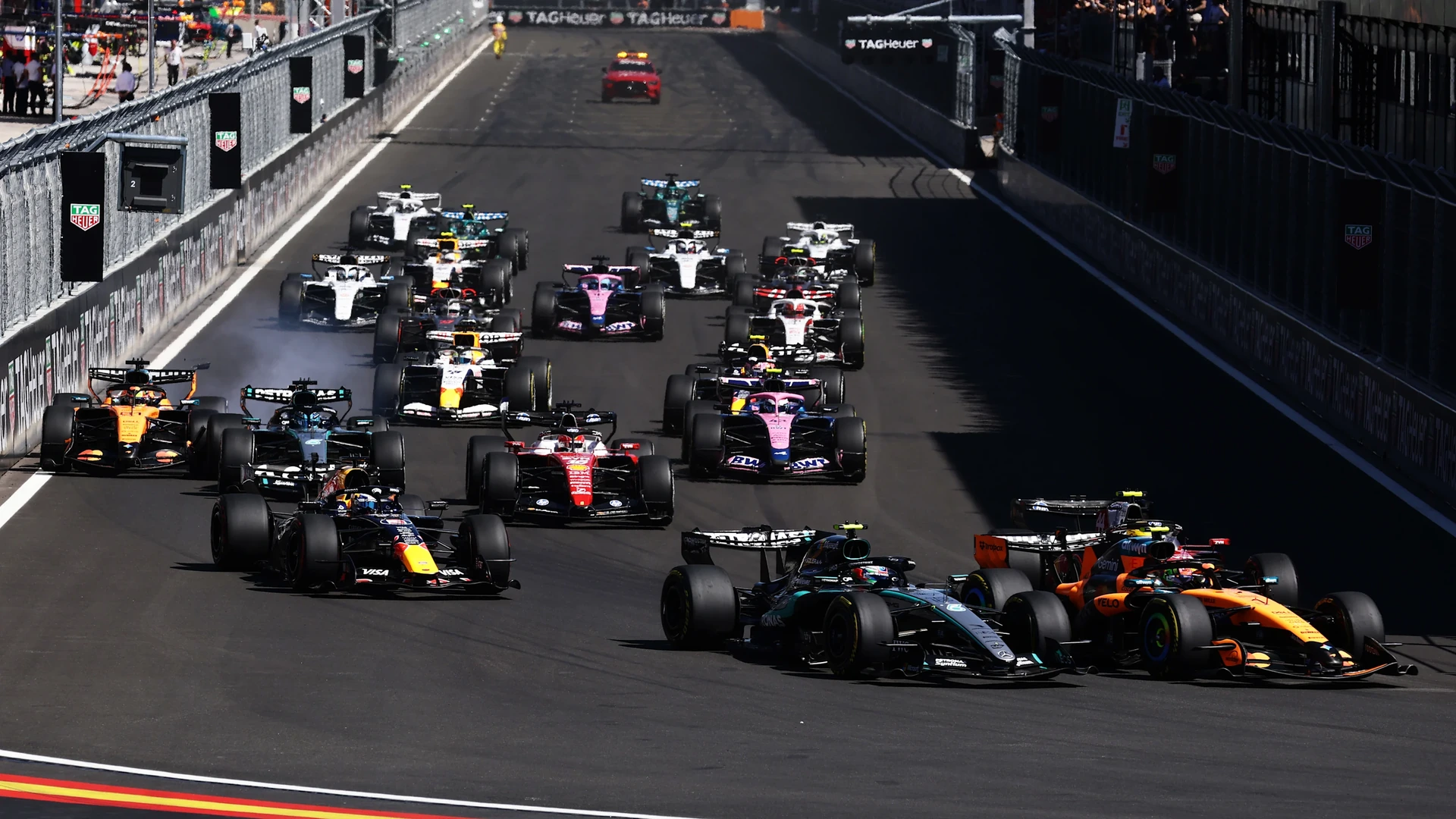
Race distance moves from 305 to 290 kilometres
The reduction corresponds to roughly two or three laps at a typical circuit and accompanies the planned fuel-flow refinement. A hard stop gives organisers and teams a known final boundary when rain or another interruption consumes a large part of the schedule. The interruption rule is designed to improve clarity for competitors, officials, broadcasters and spectators at the same time. A rule can be simple in principle while still requiring precise definitions for timing, suspension and restart procedures.
A shorter distance changes strategy only if tyre life, energy use and pit windows move enough to alter the available choices. Keeping the two-hour racing limit preserves a separate measure of actual competition inside the revised overall procedure. The change may help solve a weakness during the season, but frequent redesign would still consume budget and production capacity.
Disrupted races receive a clearer final limit
A hard stop time will define the end of activity when rain or another interruption creates a long delay. Removing the old three-hour limit avoids a rule that can conflict with a newly defined hard end to the event. Race control still needs discretion for safety, but the published stopping point reduces uncertainty about how long activity can continue.
The existing three-hour overall limit is set to disappear, while the two-hour limit for actual racing remains. Practice extensions can restore useful running after a delay, although safety and the wider support schedule still set limits. Formal approval can preserve the agreement, amend its language or delay part of the package before it becomes binding.
| Area | Agreed direction |
|---|---|
| Race distance | 290 km in 2027 |
| Interrupted races | Hard stop time; two hours of racing retained |
| Gearboxes | Homologation removed for 2027 |
| Status | Subject to WMSC approval |
Practice can recover more lost time
The proposal gives organisers greater flexibility to extend a free-practice session after an interruption. An extended session matters only when teams receive enough representative time to complete the work that was interrupted. Free-practice recovery is most valuable when an incident has denied every team the same section of planned running.
Extra time is useful when it restores representative running, but the timetable still has to protect marshals and support categories. Ending gearbox homologation gives suppliers more development freedom under the next technical framework. The current status should therefore remain clear in every summary: agreed by the Commission and still awaiting the final institutional step.
Gearbox homologation is set to end
Removing the restriction preserves more development freedom for suppliers under the 2027 technical framework. Development freedom does not remove cost, reliability or component-allocation pressures from the engineering decision. Support categories and circuit workers also require a workable timetable, so additional Formula 1 running cannot be unlimited.
Teams will still balance performance, reliability and cost instead of treating freedom as a reason for constant replacement. Teams will need the final wording before simulations can model every operational consequence with confidence. Technical directives and detailed sporting wording will explain how exceptional cases are handled after approval.
Approval remains an important final step
The Commission agreement establishes direction but does not bypass the World Motor Sport Council’s formal process. Circuit length means the exact lap count will vary even though the target distance is common across standard Grands Prix. Gearbox suppliers can pursue performance or reliability changes without waiting for a new homologation cycle.
The measures therefore remain agreed proposals until that approval completes their regulatory status. A shorter race may move pit windows slightly without automatically creating an extra stop or removing one. Teams prefer early clarity because car design, simulation and operational planning begin long before the first 2027 race.


No Comments